Only first-class identity. http://amzn.to/2iuS4FV
Book: Who owns the future
Know more
Claiming a first-class self online
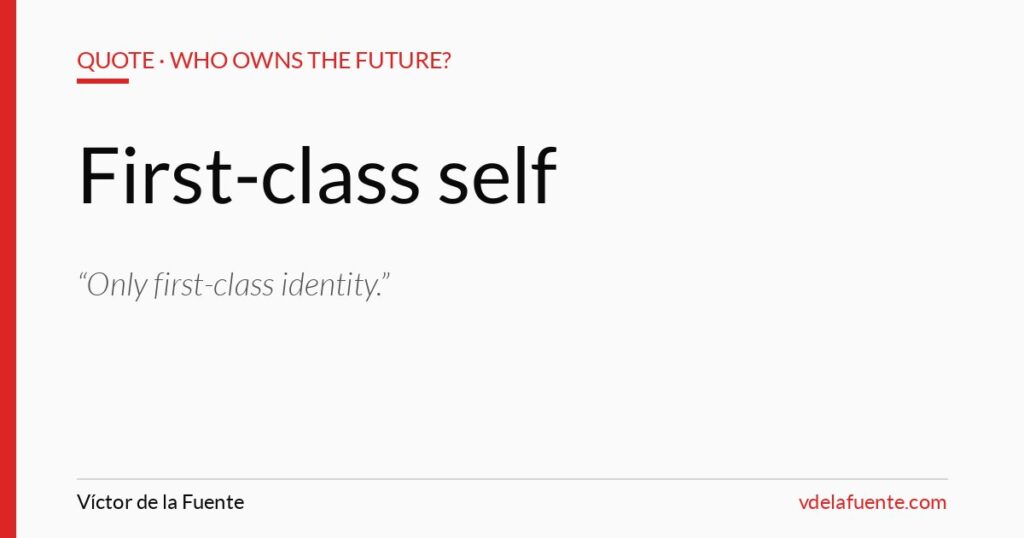
Jaron Lanier uses a short phrase in Who Owns the Future? Only first-class identity. He argues that people should be treated as full participants in the digital economy, not as anonymous sources of data. A first-class self means recognition, rights and a fair share of the value we help create.
Today, much online activity feeds platforms that profit from user data. Searches, photos, reviews and clicks train algorithms and target ads. Yet most users receive little in return beyond free services. Lanier sees this as treating people as second-class contributors.
What a first-class self could mean
Lanier proposes that people could receive small payments when their data creates value. This idea, sometimes called data dignity, remains debated. However, it raises a useful question. Who benefits from what we share online, and on what terms?
On a personal level, a first-class identity starts with awareness. Read privacy settings, choose services carefully and think before sharing. For example, using tools that respect privacy is a small way to assert control.
Professionally, it also means building your own presence. A personal website, newsletter or portfolio gives you ownership that platforms cannot remove. Therefore, your reputation rests on ground you control.
Moreover, communities and regulations play a role. Laws like the European GDPR give individuals more rights over their data.
Of course, convenience often pulls in the opposite direction. Balance is personal, and every choice involves trade-offs.
In the end, Lanier’s phrase asks for dignity online. Being a full participant, not just a product, is a goal worth pursuing.
In addition, digital literacy supports a first-class identity. Understanding how platforms make money, how algorithms rank content and how data travels empowers people to make informed choices. Consequently, education about technology is not only for engineers. It is an essential skill for anyone who lives and works online today.
In short, dignity online is a shared project. Meanwhile, each user can still act. For example, reading a privacy policy once a year takes minutes. Consequently, small habits like this, repeated by many people, slowly push the market towards fairer terms.