People deal with each other politically because the material advantages are compelling. http://amzn.to/2iuS4FV
Book: Who owns the future
Know more
Compelling advantages and the politics of everyday life
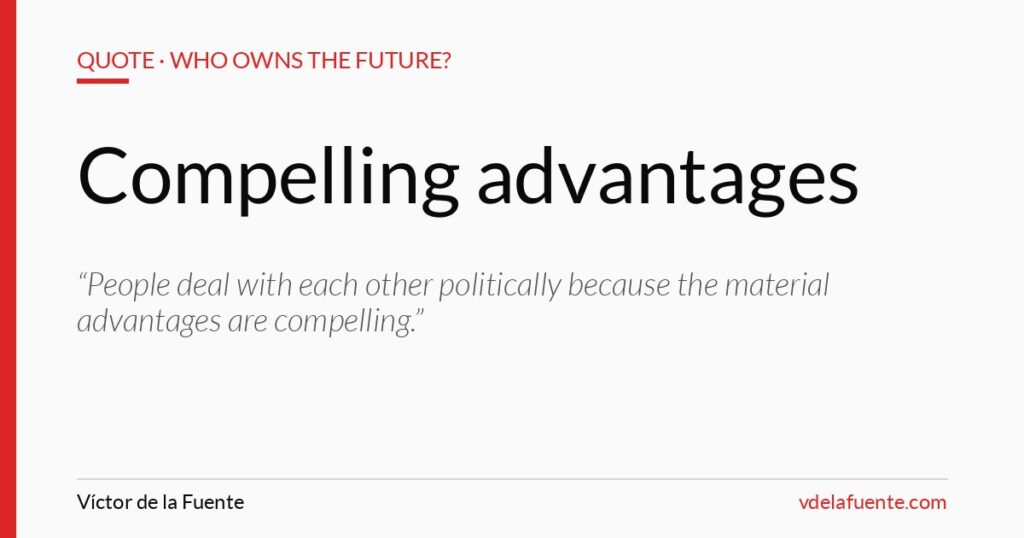
Jaron Lanier offers a sober observation in Who Owns the Future? People deal with each other politically because the material advantages are compelling. Politics, in this sense, is not only about elections. It is about how people negotiate, ally and compete whenever resources or status are at stake.
Office life illustrates this clearly. Colleagues form alliances, trade favours and manage impressions. Some see this as cynical. However, it often reflects rational responses to incentives. When promotions, budgets or recognition depend on relationships, people naturally invest in those relationships.
How compelling advantages shape behaviour
Understanding incentives helps explain behaviour without moralising. If a sales team competes for individual bonuses, collaboration may suffer. If a company rewards only short-term results, long-term projects may be neglected. Therefore, changing incentives often changes behaviour more effectively than speeches about values.
Charlie Munger famously said that if you show him the incentive, he will show you the outcome. The idea applies to families, governments and markets. For example, policies that reward saving tend to increase saving, while policies that punish honesty discourage it.
On a personal level, awareness of incentives brings clarity. When someone gives advice, ask what they gain if you follow it. When you make decisions, notice which rewards are pulling you. Moreover, this awareness protects you from manipulation.
Political behaviour is not always negative. Building coalitions, persuading others and negotiating fairly are essential skills. They help good ideas gain support and turn plans into reality.
The challenge is to keep ethics alongside strategy. Pursuing advantage while respecting others creates trust, which becomes its own long-term advantage.
In the end, Lanier’s observation invites realism. People respond to incentives. Designing better incentives, and understanding our own, makes cooperation easier and outcomes fairer.