Know more
Framing always leaves something out
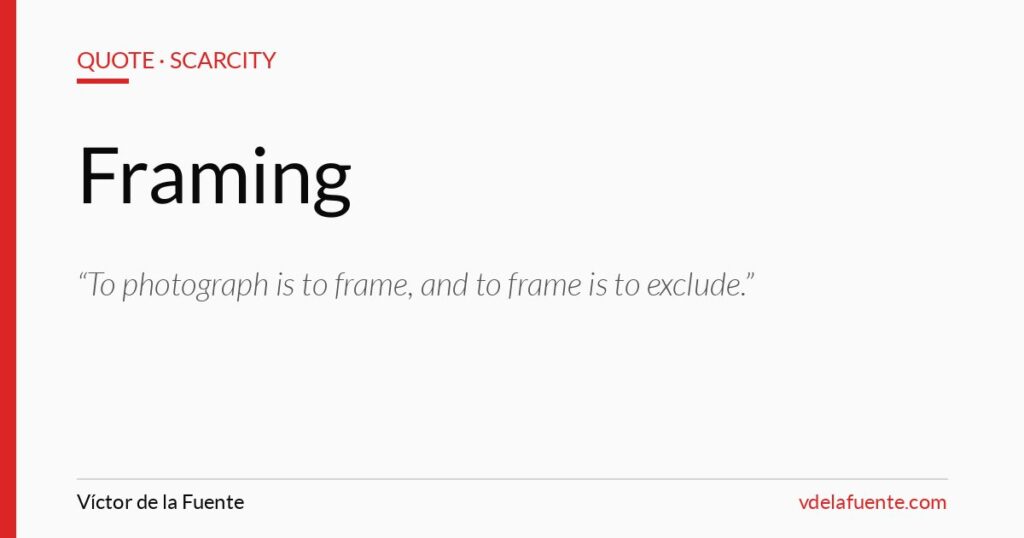
Scarcity includes a line borrowed from photography. To photograph is to frame, and to frame is to exclude. Every picture shows something by hiding everything else. Our minds work in the same way. When we focus on one issue, we inevitably push others outside the frame.
This is not a flaw to fix. Instead, it is how attention works. We cannot see everything at once. However, problems appear when we forget that the frame exists. Then we treat the visible part as the whole story, and our decisions suffer.
Choosing your framing on purpose
Framing also shapes how messages are received. Kahneman and Tversky showed that people react differently to the same facts depending on presentation. A treatment with a ninety per cent survival rate sounds better than one with a ten per cent death rate, even though they are identical.
In business, framing influences pricing, negotiations and marketing. For example, a subscription described as less than a coffee a day feels cheaper than the same yearly price shown in one number. Therefore, it pays to notice how options are presented to you, and how you present them to others.
On a personal level, try reframing difficult situations. A rejection can be seen as failure or as information. A delay can be seen as wasted time or as space to prepare. Moreover, changing the frame does not change the facts, but it often changes what you do next.
In the end, every frame is a choice. By widening it from time to time, we see what we left out. And by choosing it deliberately, we make sure the picture serves our goals rather than hiding them.
Also, consider how you frame your own goals. Saying I want to avoid failure feels very different from saying I want to learn something new. The second frame, therefore, tends to encourage exploration and resilience. Small changes in wording can shift energy in a surprisingly strong way.