It is not the siren who harms the sailor, but the sailor’s inability to think straight. So it is with us and our machines. http://amzn.to/2iuS4FV
Book: Who owns the future
Know more
The sailor and machines: who is really at risk
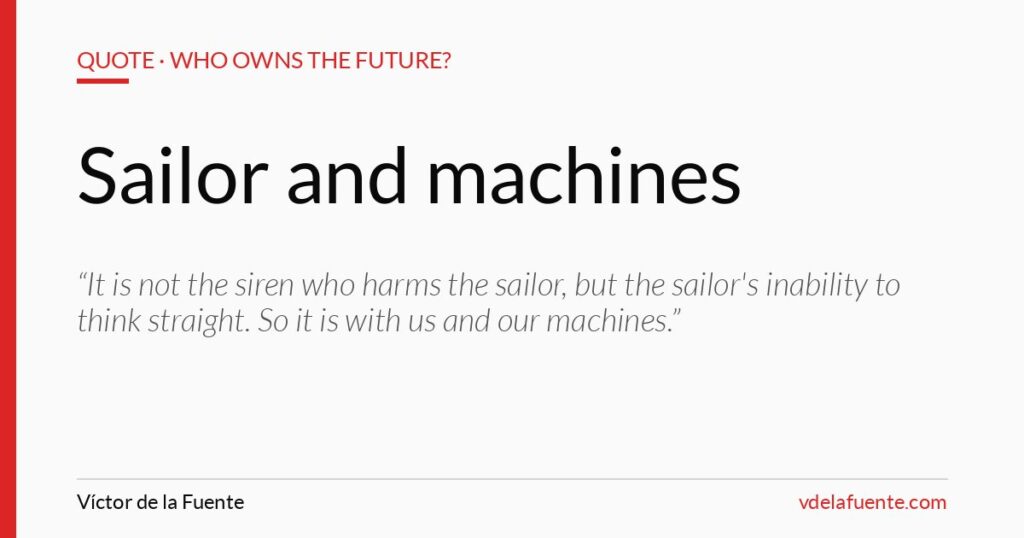
Jaron Lanier revisits an ancient myth in Who Owns the Future? It is not the siren who harms the sailor, but the sailor’s inability to think straight. So it is with us and our machines. The danger, in his view, lies less in technology itself than in how we respond to its pull.
In Homer’s Odyssey, Odysseus wants to hear the sirens’ song without crashing. He asks his crew to tie him to the mast and plug their own ears with wax. He does not destroy the sirens. Instead, he designs a system that protects him from his own weakness at the critical moment.
Lessons from the sailor and machines
That story offers a practical model for digital life. Apps and feeds are designed to capture attention, much like the sirens’ song. Rather than relying on willpower alone, we can tie ourselves to the mast. Blocking tools, scheduled phone-free time and notification settings act like ropes and wax.
Behavioural economists call this a commitment device. People who set rules in advance, such as limiting social media to certain hours, tend to follow through better than those who decide in the moment. Therefore, planning ahead is often more effective than resisting temptation live.
Organisations can apply the same thinking. Clear policies about meeting-free hours or email response times protect teams from constant distraction. For example, some companies block internal messaging during focus periods to protect deep work.
Moreover, critical thinking remains essential. Understanding how persuasive design works helps us notice when we are being pulled. Awareness alone does not solve everything, yet it makes better choices possible.
Designers carry responsibility too. Products can be built to respect users rather than exploit them, and some companies now measure success by user wellbeing, not only engagement.
In the end, Lanier’s metaphor shifts responsibility without blaming users. Machines will keep singing. Our task is to think clearly, design safeguards and steer our own ship.